


It is a long-held belief that turtles can tuck their heads into their shells when threatened. But is it true? And is it this defense that turtles around the world have shells today?
The answer, experts told Live Science, is that some types of turtles can, and some cannot. And while shells may be protective for some of these reptiles, fossil evidence suggests that shells evolved for entirely different reasons.
you may like
Some terrestrial turtles, which divide their time between land and water, are capable of similar behavior.
“Turtles have two ways to tuck their heads in,” Jason Head, professor of vertebrate evolution and ecology at the University of Cambridge, told Live Science. “There are what are called side-neck turtles. They have long necks and literally fold their head and neck over one arm to the side. And then there are snake-neck or S-neck turtles that can put a loop around their neck and actually pull their neck into the shoulder girdle.”
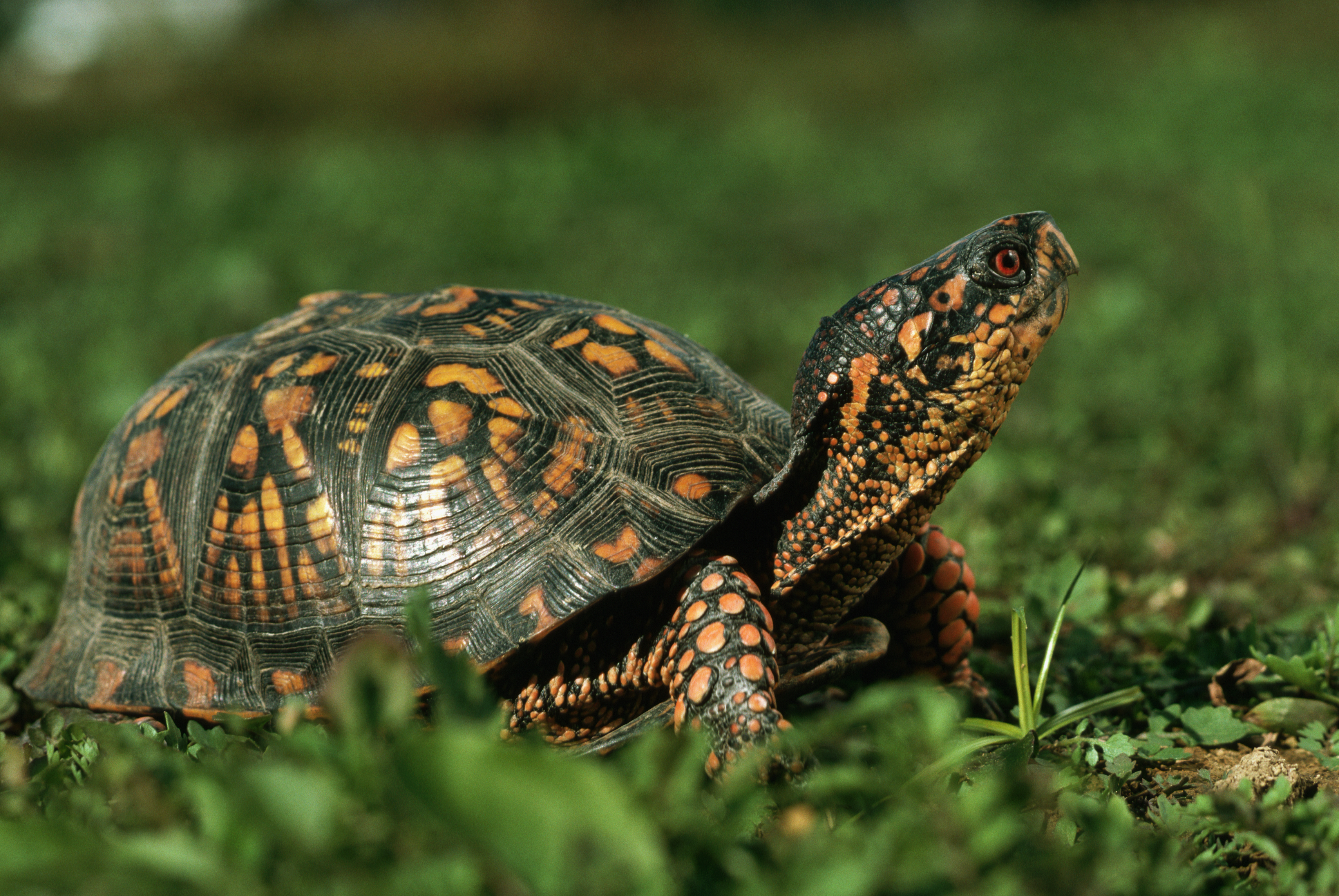
One example is the eastern box turtle (Terrapene carolina carolina). Its bottom carapace, known as the plastron, is fitted with a hinge that also allows the carapace to close completely.
However, sea turtles are a type of turtle that cannot pull their heads into their shells. Sea turtles have much smoother, lighter shells and don’t have the space to push their heads inside. “This is to reduce the load,” Head said, which allows sea turtles to swim faster to escape predators.
How did turtle shells evolve?
So how did some turtles develop this life-saving trick? To find out, we need to look at how turtle shells evolved, dating back almost 300 million years in the fossil record.
“A turtle’s shell is a complex structure, made up of more than 50 bones,” Lyson said. “Bone” is the key word, because fossils reveal that the turtle’s shell is part of its skeleton. And although modern turtle shells look like solid units, they are actually made up of two skeletal features that evolved separately.
“The first thing we see in the evolution of turtle shells is the expansion of the ribs, which is also seen in Eunotosaurus africanus, an animal that lived in southern Africa 260 million years ago, before dinosaurs roamed the earth,” Lyson told Live Science. Dr. Lyson first described Eunotosaurus’ contribution to turtle evolution in a 2013 study. Researchers believe that these creatures spent time burrowing underground to escape the heat, and that the development of wider ribs supported more muscle mass, making this possible.
you may like
Then, in 2015, a 240-million-year-old fossil called Pappocheris was discovered in Germany, showing that the shellless animal had broad upper ribs paired with thick abdominal ribs known as gastralia. By 220 million years ago, an aquatic animal called Odontochelis, discovered in China, had developed a fully integrated ventral plate, or plastron, from its expanding abdomen.
“Myself and others believe that the evolution of the plastron was essentially a ballast to get deeper into the water column,” Lyson explained. The plastron may also have developed to protect turtles from predators swimming below, he said.

The first evidence of a fully formed turtle shell was discovered 210 million years ago in the form of a fossilized creature called Proganocheris. Its thick upper ribs were fused with dermal bone to form a closed carapace and attached to the lower plastron. Lyson explained that the opening in the turtle’s head was formed by the shoulder bone that connects the top and bottom of the shell.
Most evidence suggests that these reptilian creatures called pantestudines eventually led to modern turtles. But Head pointed out that similar features, such as spread and overlapping ribs, developed millions of years ago in other animals, including those thought to be more closely related to mammals.
“This is an active area of research, and new discoveries are being made all the time,” Head said.
Although the shells of these turtle ancestors developed in response to a variety of evolutionary pressures, Lyson notes that turtle shells are now primarily used for self-defense. “Modern functionality is not necessarily related to how that functionality came about,” he says. “We didn’t realize it was for protection until the shell fully emerged.”
The resilient shells of turtles have seen these creatures through about 300 million years of history, and Lyson believes it’s one of the reasons they were able to survive three of Earth’s five mass extinctions.
“We’re looking at the fossil record and we can see the sand line where dinosaurs and many other things went extinct,” Lyson said. “And you see turtles marching across that line.”
Evolution Quiz: Can you choose the correct answer naturally?
Source link
