


The EURATOM SOCRATES project investigates liquid source term phenomena associated with serious accidents in nuclear power plants and develops innovative methods and computer models for liquid source term management.
“Liquid source term” refers to radioactive materials present in various liquid pathways, such as containment sump, cooling water, and groundwater, during and after a major nuclear power plant (NPP) accident. Since the Fukushima Daiichi nuclear power plant accident, interest in this topic has increased significantly due to the challenges of treating large amounts of contaminated water and understanding the behavior of radionuclides in water.
The EURATOM SOCRATES project (2024-2028) will address critical gaps in the understanding of liquid source terminology during major nuclear accidents and provide innovative solutions for mitigating and monitoring releases of radionuclides to the environment. This is important for light water reactors in existing large nuclear power plants and for future small modular reactors (SMRs) that may be located near populated areas such as cities.
the purpose
By advancing scientific knowledge and technological capabilities, Socrates improves safety, environmental protection, safe waste management, public welfare, and contributes to medium- and long-term accident management of nuclear power plants.
Socrates consists of three main parts.
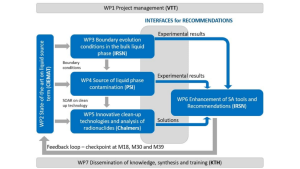
We review the current knowledge about liquid source term phenomena associated with serious nuclear power plant accidents. Experimental research on the evolution of liquid phase chemistry, fuel debris leaching, innovative absorbers for radionuclides, and the development of compact radiochemistry laboratories. Define the main chemical processes for Cs, Sr, and U in the liquid phase (e.g., containment sump) and develop a mathematical model.
Figure 1 shows the SOCRATES work packages and their interrelationships.
Expected impact
SOCRATES’ unique contribution benefits nuclear safety and society through several outcomes.
Comprehensive state-of-the-art report: SOCRATES reviews the current understanding of liquid source terms in severe accidents, with an emphasis on evaluating the capabilities of existing accident analysis codes (e.g., predicting species formation in the liquid phase in both soluble and insoluble forms). This report establishes a baseline and consolidates project results across all areas studied. Experimental Database: SOCRATES is developing a database on water chemistry during nuclear accidents by cataloging the materials (concrete, paint, metals, etc.) that may interact under different accident scenarios. Experiments will focus on investigating the behavior of specific fission products such as cesium (Cs) and strontium (Sr) in water and the leaching of fuel debris, including tests using actual corium samples. This database supports the development of computer models. New computer code model: SOCRATES will develop a computer code model that can predict and manage the potential release of radioactive material in liquid form during a major accident at a nuclear power plant. The model addresses various scenarios regarding the behavior of fission products in water environments during severe accidents. The ultimate goal is to validate the developed model and integrate it into European safety analysis codes (ASTEC, AC2, etc.) to support further accident management activities. Innovative Absorbent Materials: Mitigating the release of liquid radioactive material during severe accidents requires innovative and effective cleanup technologies. Promising sorbents (zeolites, clays, MOFs, silica, etc.) have been identified and their performance will be demonstrated, including the synthesis of the materials themselves. Innovative miniature radiochemistry laboratory: A new miniature radiochemistry laboratory is being developed at SOCRATES to enable early measurements of target radionuclides such as Cs and Sr. Communication, dissemination, and utilization: In addition to research activities, effective communication, dissemination, and utilization of SOCRATES results is important. This includes, for example, the preparation of scientific publications and educational materials, and the organization of researcher mobility programs.
partner
VTT, ASNR (formerly IRSN), CEA, Chalmers, CIEMAT, EDF, ETH, Framatome, GRS, JRC, KTH, KU, NUVIA, PSI, RUB PSS, SSTC NRS, UL.
end user group
If you would like to learn more about the SOCRATES project and track its progress and results, please contact socrates.eu@vtt.fi and join the end-user group.
This project is supported by grant HORIZON-EURATOM-2023-NRT-01. Contract number 101163745.
This article will also be published in the quarterly magazine issue 25.
Source link
