Close Menu
  • Home
  • Identity
  • Inventions
  • Future
  • Science
  • Startups
  • Spanish
What's Hot

Waymo temporarily suspends service in San Francisco as robotaxis stall due to power outage

Electrical startups raise concerns as EU wateres down 2035 EV targets

Famous Israeli VC John Medved, who was diagnosed with ALS, championed technology to improve his life.

Facebook X (Twitter) Instagram
  • Home
  • About Us
  • Advertise with Us
  • Contact Us
  • DMCA
  • Privacy Policy
  • Terms & Conditions
  • User-Submitted Posts
Facebook X (Twitter) Instagram
Fyself News
  • Home
  • Identity
  • Inventions
  • Future
  • Science
  • Startups
  • Spanish
Fyself News
Home » James Webb Telescope discovers ‘monster star’ leaking nitrogen in the early universe – could help solve big mysteries
Science

James Webb Telescope discovers ‘monster star’ leaking nitrogen in the early universe – could help solve big mysteries

userBy userDecember 11, 2025No Comments4 Mins Read
Share Facebook Twitter Pinterest Telegram LinkedIn Tumblr Email Copy Link
Follow Us
Google News Flipboard
Share
Facebook Twitter LinkedIn Pinterest Email Copy Link

Scientists using the James Webb Space Telescope (JWST) have discovered the first evidence of a “monster star” in the early universe. This provides new clues about how supermassive black holes got so big just a billion years into the universe’s history.

The research team discovered these giant stars, with masses between 1,000 and 10,000 times that of the Sun, in a galaxy called GS 3073, which formed about a billion years after the Big Bang. It is thought that these monster stars led to the formation of the earliest supermassive black holes.

The study was co-led by scientists at the Harvard-Smithsonian Center for Astrophysics (CfA) and the University of Portsmouth in the United Kingdom, and was published November 12 in Astrophysical Journal Letters.

you may like

“Our latest discovery helps solve a 20-year-old cosmic mystery,” study co-author Daniel Whalen of the Portsmouth Space and Gravity Institute said in a statement. “These cosmic giants would have burned brightly for a short time before collapsing into massive black holes, leaving chemical signatures that we could detect billions of years later.”

“A bit like dinosaurs on Earth, but they were huge and primitive,” Whalen added. “And they were short-lived, lasting only 250,000 years, a cosmic blink of an eye.”

The significance of this work includes not only learning about the first generation of stars, but also shedding light on the so-called “dark ages of the universe,” when the first stars came to light and the chemistry of the universe began to change.

unique sign

According to the researchers, GS 3073’s star had an unusual and “extreme” imbalance of nitrogen and oxygen (ratio 0.46), which is not normally seen in stars or stellar explosions. However, this feature was consistent with what was predicted by the model. “Protostars are thousands of times more massive than the Sun,” said study co-author Devesh Nandal, a postdoctoral fellow at the CfA Institute for Theoretical Computation.

Get the world’s most fascinating discoveries delivered straight to your inbox.

How did these stars produce so much nitrogen? The researchers said it was a three-step process. Stars are constantly burning elements in their cores. When these large stars in GS 3073 burned helium, a chemical reaction produced carbon. Eventually, carbon began to invade the outer shell of the material where hydrogen was being burned. Inside its outer shell, carbon and hydrogen mix to form nitrogen.
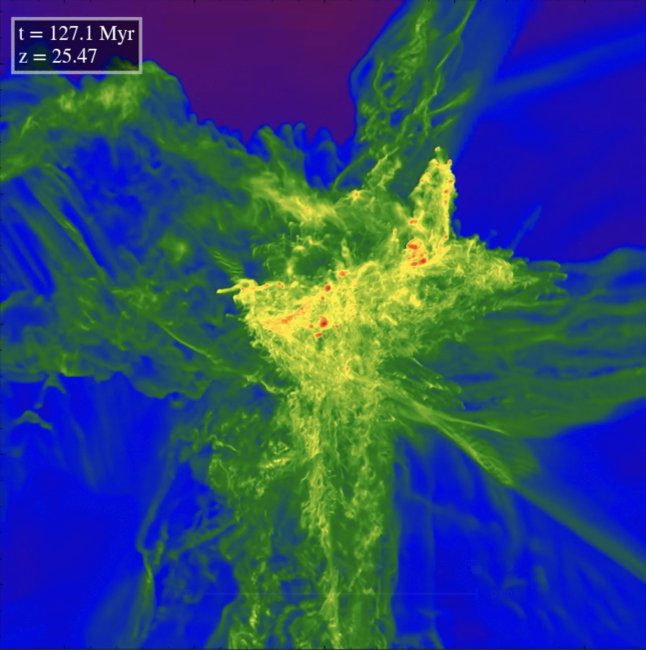
Simulation of a huge star collapsing into a black hole

This simulated image from the research team’s work shows the birth of an ancient quasar, or extremely bright and active black hole, made possible by the collapse of a giant “monster star.” (Image credit: Nadal et al.)

Once the nitrogen was produced, convection currents inside the star began distributing it throughout the star’s body. Over time, nitrogen flowed out of the star and into space. In the case of GS 3073, this process lasted for millions of years.

“This study also found that this nitrogen signature only appears in a specific mass range,” the researchers noted. “Stars smaller than 1,000 solar masses or larger than 10,000 solar masses do not produce chemical patterns suitable for the signature, suggesting a ‘sweet spot’ for this type of enrichment.”

The mystery of giant black holes

Based on their model, the researchers also suggested that these monster stars do not explode into supernovae at the end of their lives. What happens next is a massive collapse, creating part of the universe’s oldest supermassive black hole.

Adding further fuel to this idea, GS 3073 appears to have an actively feeding black hole at its center, “which could be the remnant of one of these supermassive first stars,” the statement said. “If confirmed, it would simultaneously solve two mysteries: where the nitrogen came from and how black holes formed.”

The origin of the universe’s first supermassive black hole remains one of the greatest mysteries in astrophysics. Some theories suggest that it collapsed directly from a super-dense cloud of gas shortly after the Big Bang, and then galaxies formed around it. Other theories point to more exotic explanations, such as dark matter interactions or the collapse of a monster star. Ultimately, further research is needed to solve this ancient puzzle.


Source link

#Biotechnology #ClimateScience #Health #Science #ScientificAdvances #ScientificResearch
Follow on Google News Follow on Flipboard
Share. Facebook Twitter Pinterest LinkedIn Tumblr Email Copy Link
Previous ArticleOpenAI hits back at Google with GPT-5.2 after ‘Code Red’ memo
Next Article Study finds killer whales work with dolphins to hunt salmon – but not everyone agrees
user
  • Website

Related Posts

This week’s science news: Japan’s laser weapons test bids farewell to Comet 3I/ATLAS, AI solves ‘impossible’ math problem

December 20, 2025

Interstellar comet 3I/ATLAS is rapidly moving away from us. Can we ‘intercept’ it before it leaves us forever?

December 19, 2025

AI is solving ‘impossible’ math problems. Can it best the world’s top mathematicians?

December 19, 2025
Add A Comment
Leave A Reply Cancel Reply

Latest Posts

Waymo temporarily suspends service in San Francisco as robotaxis stall due to power outage

Electrical startups raise concerns as EU wateres down 2035 EV targets

Famous Israeli VC John Medved, who was diagnosed with ALS, championed technology to improve his life.

Iran’s Infy APT resurfaces with new malware activity after years of silence

Trending Posts

Subscribe to News

Subscribe to our newsletter and never miss our latest news

Please enable JavaScript in your browser to complete this form.
Loading

Welcome to Fyself News, your go-to platform for the latest in tech, startups, inventions, sustainability, and fintech! We are a passionate team of enthusiasts committed to bringing you timely, insightful, and accurate information on the most pressing developments across these industries. Whether you’re an entrepreneur, investor, or just someone curious about the future of technology and innovation, Fyself News has something for you.

Castilla-La Mancha Ignites Innovation: fiveclmsummit Redefines Tech Future

Local Power, Health Innovation: Alcolea de Calatrava Boosts FiveCLM PoC with Community Engagement

The Future of Digital Twins in Healthcare: From Virtual Replicas to Personalized Medical Models

Human Digital Twins: The Next Tech Frontier Set to Transform Healthcare and Beyond

Facebook X (Twitter) Instagram Pinterest YouTube
  • Home
  • About Us
  • Advertise with Us
  • Contact Us
  • DMCA
  • Privacy Policy
  • Terms & Conditions
  • User-Submitted Posts
© 2025 news.fyself. Designed by by fyself.

Type above and press Enter to search. Press Esc to cancel.