Close Menu
  • Home
  • Identity
  • Inventions
  • Future
  • Science
  • Startups
  • Spanish
What's Hot

US HPC research accelerates non-equilibrium quantum materials

Android malware operations massively merge dropper, SMS theft, and RAT capabilities

Waymo temporarily suspends service in San Francisco as robotaxis stall due to power outage

Facebook X (Twitter) Instagram
  • Home
  • About Us
  • Advertise with Us
  • Contact Us
  • DMCA
  • Privacy Policy
  • Terms & Conditions
  • User-Submitted Posts
Facebook X (Twitter) Instagram
Fyself News
  • Home
  • Identity
  • Inventions
  • Future
  • Science
  • Startups
  • Spanish
Fyself News
Home » Strange bursts of energy traveling at 99% of the speed of light are unlike anything scientists have seen before — Space Photo of the Week
Science

Strange bursts of energy traveling at 99% of the speed of light are unlike anything scientists have seen before — Space Photo of the Week

userBy userDecember 14, 2025No Comments3 Mins Read
Share Facebook Twitter Pinterest Telegram LinkedIn Tumblr Email Copy Link
Follow Us
Google News Flipboard
Share
Facebook Twitter LinkedIn Pinterest Email Copy Link

simple facts

What is it: Gamma ray burst GRB 250702B

Location: 8 billion light years away, in the constellation Scutum.

Share date: December 8, 2025

Gamma-ray bursts (GRBs) are the most energetic type of explosion in the universe since the Big Bang, and are detected on average once every day. But what happened on July 2, 2025 was very unusual. NASA’s Fermi Gamma-ray Space Telescope, which has been in orbit around Earth since 2008, has recorded an unusually long-lived GRB that continues to emit in bursts for more than seven hours.

Astronomers sprang into action using telescopes around the world to detect the explosion’s afterglow and figure out where it came from.

The phenomenon, called GRB 250702B, was the longest-duration gamma-ray burst ever recorded. Astronomers now believe the explosion was the result of a previously unseen or rare type of explosion that shot a thin jet of material toward the solar system, traveling at at least 99 percent of the speed of light.

you may like

Understanding GRB 250702B was not easy. The researchers traced its origins at every wavelength of light using all kinds of telescopes, including the twin 8.1-meter-diameter Gemini telescopes in Chile and Hawaii, the Very Large Telescope in Chile, the Keck Observatory in Hawaii, and the Hubble Space Telescope.

GRBs come from deep in space. The closest one originated more than 100 million light years away, according to NASA. GRB 250702B comes from a massive galaxy 8 billion light years away. This galaxy was so dusty that it blocked out all visible light.

The only light the telescope detected was in the infrared and high-energy X-ray wavelengths. Because of the thick dust within its host galaxy, the GRB is nearly invisible in normal visible light, the researchers reported in a study published Nov. 26 in The Astrophysical Journal Letters.
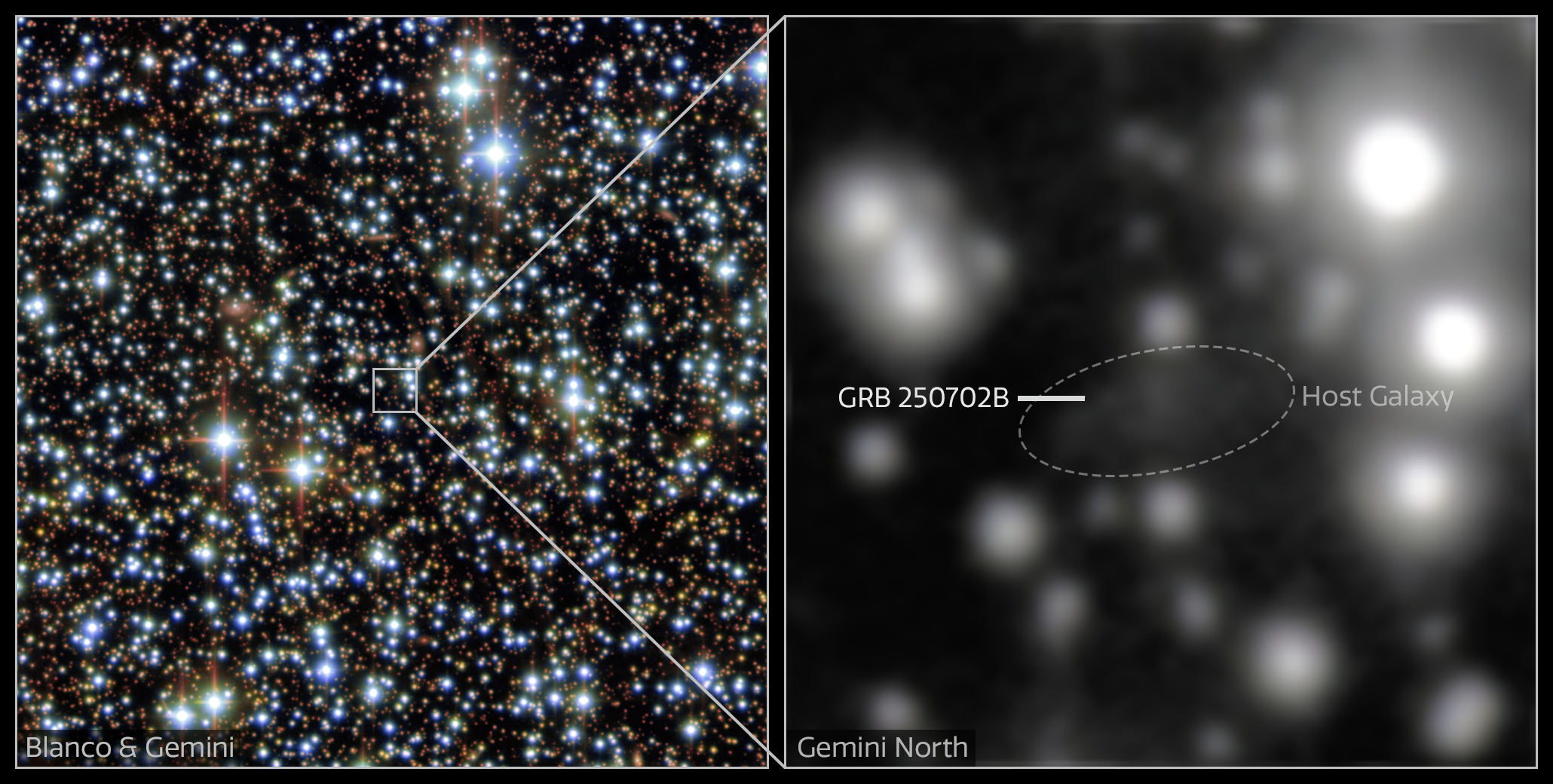
Two images. On the left is a telescope image of thousands of stars in a black sky. On the right is a close-up of a circle around the galaxy that hosts GRB 250702B.

In October, the infrared James Webb Space Telescope zoomed in on GRB 250702B’s host galaxy, providing the clearest view yet. (Image credits: NASA, ESA, CSA, H. Sears (Rutgers). Image processing: A. Pagan (STScI))

“This was the longest gamma-ray burst ever observed by humans, and its length is such that it defies any existing model for the cause of gamma-ray bursts,” said study lead author Jonathan Carney, a doctoral student in physics and astronomy at the University of North Carolina at Chapel Hill, in a statement.

Get the world’s most fascinating discoveries delivered straight to your inbox.

Analysis shows that GRB 250702B could have been caused by the death of a massive star, the star being torn apart by a black hole, or the merger of a helium star and a black hole, with the black hole spiraling into the center of the massive star and causing it to explode from within.

“But we still don’t know which explanation is correct,” Carney said. “In the future, this phenomenon will serve as its own benchmark. When astronomers discover a similar explosion, they will ask whether it matches the properties of GRB 250702B or represents something completely different.”

For more sublime space images, check out this week’s space photo archive.


Source link

#Biotechnology #ClimateScience #Health #Science #ScientificAdvances #ScientificResearch
Follow on Google News Follow on Flipboard
Share. Facebook Twitter Pinterest LinkedIn Tumblr Email Copy Link
Previous ArticleCan turtles push their heads completely inside their shells?
Next Article Scientists have finally decoded the vampire squid’s giant genome, revealing the secret of its ‘living fossil’
user
  • Website

Related Posts

This week’s science news: Japan’s laser weapons test bids farewell to Comet 3I/ATLAS, AI solves ‘impossible’ math problem

December 20, 2025

Interstellar comet 3I/ATLAS is rapidly moving away from us. Can we ‘intercept’ it before it leaves us forever?

December 19, 2025

AI is solving ‘impossible’ math problems. Can it best the world’s top mathematicians?

December 19, 2025
Add A Comment
Leave A Reply Cancel Reply

Latest Posts

US HPC research accelerates non-equilibrium quantum materials

Android malware operations massively merge dropper, SMS theft, and RAT capabilities

Waymo temporarily suspends service in San Francisco as robotaxis stall due to power outage

Electrical startups raise concerns as EU wateres down 2035 EV targets

Trending Posts

Subscribe to News

Subscribe to our newsletter and never miss our latest news

Please enable JavaScript in your browser to complete this form.
Loading

Welcome to Fyself News, your go-to platform for the latest in tech, startups, inventions, sustainability, and fintech! We are a passionate team of enthusiasts committed to bringing you timely, insightful, and accurate information on the most pressing developments across these industries. Whether you’re an entrepreneur, investor, or just someone curious about the future of technology and innovation, Fyself News has something for you.

Castilla-La Mancha Ignites Innovation: fiveclmsummit Redefines Tech Future

Local Power, Health Innovation: Alcolea de Calatrava Boosts FiveCLM PoC with Community Engagement

The Future of Digital Twins in Healthcare: From Virtual Replicas to Personalized Medical Models

Human Digital Twins: The Next Tech Frontier Set to Transform Healthcare and Beyond

Facebook X (Twitter) Instagram Pinterest YouTube
  • Home
  • About Us
  • Advertise with Us
  • Contact Us
  • DMCA
  • Privacy Policy
  • Terms & Conditions
  • User-Submitted Posts
© 2025 news.fyself. Designed by by fyself.

Type above and press Enter to search. Press Esc to cancel.