Close Menu
  • Home
  • Identity
  • Inventions
  • Future
  • Science
  • Startups
  • Spanish
What's Hot

Waymo temporarily suspends service in San Francisco as robotaxis stall due to power outage

Iran’s Infy APT resurfaces with new malware activity after years of silence

Google and Apple reportedly warned employees with visas to avoid traveling abroad

Facebook X (Twitter) Instagram
  • Home
  • About Us
  • Advertise with Us
  • Contact Us
  • DMCA
  • Privacy Policy
  • Terms & Conditions
  • User-Submitted Posts
Facebook X (Twitter) Instagram
Fyself News
  • Home
  • Identity
  • Inventions
  • Future
  • Science
  • Startups
  • Spanish
Fyself News
Home » Time moves faster on Mars, proving Einstein right and posing new challenges for human missions
Science

Time moves faster on Mars, proving Einstein right and posing new challenges for human missions

userBy userDecember 11, 2025No Comments4 Mins Read
Share Facebook Twitter Pinterest Telegram LinkedIn Tumblr Email Copy Link
Follow Us
Google News Flipboard
Share
Facebook Twitter LinkedIn Pinterest Email Copy Link

Scientists have discovered that time moves slightly faster on the Red Planet than on Earth. Clocks on Mars, when measured from Earth, run an average of 0.477 milliseconds (477 microseconds) faster in a 24-hour period compared to time recorded on Earth, a new study has found. Knowing this difference may help establish an “internet” throughout the solar system.

In the coming decades, humanity’s presence in the solar system will increase, and missions like NASA’s Artemis mission are expected to pave the way for permanent settlements on the moon and beyond. Developing a standard clock for each location in space would help astronauts navigate these worlds while coordinating communications with Earth.

However, there is a catch. Time does not flow at the same pace everywhere. Albert Einstein’s theory of general relativity states that time in a particular region depends on the strength of gravity in that region. Clocks in areas with high gravity tick more slowly than in areas with lower gravity. So people who live on top of mountains age a few milliseconds faster than people who live at sea level. (At high altitudes, the influence of Earth’s gravity becomes smaller, and time appears to move faster.)

you may like

Additionally, time on a planet depends on its velocity around its parent star. The faster the orbital speed, the faster time passes.

Time keeps slipping away

When measured from Earth, speed and gravity cause time to tick at different rates for different solar system objects. A 2024 study calculated that the moon’s clock would be on average 56 microseconds (one millionth of a second) faster than Earth’s clock. After establishing this, physicists Neil Ashby and Bijnath Patra of the National Institute of Standards and Technology in Boulder, Colorado, turned their attention to Mars.

First, they chose a reference level on Mars, called the Arade, which corresponds to Earth’s sea level. They then used physics-based formulas to calculate how the gravity and velocity of Mars and Earth affect time on Mars in Leoid. Mars’ slow orbital speed compared to Earth would slow down a Mars-based clock, but Mars’ weak surface gravity, which is one-fifth less than Earth’s sea-level gravity, would make the clock even faster.
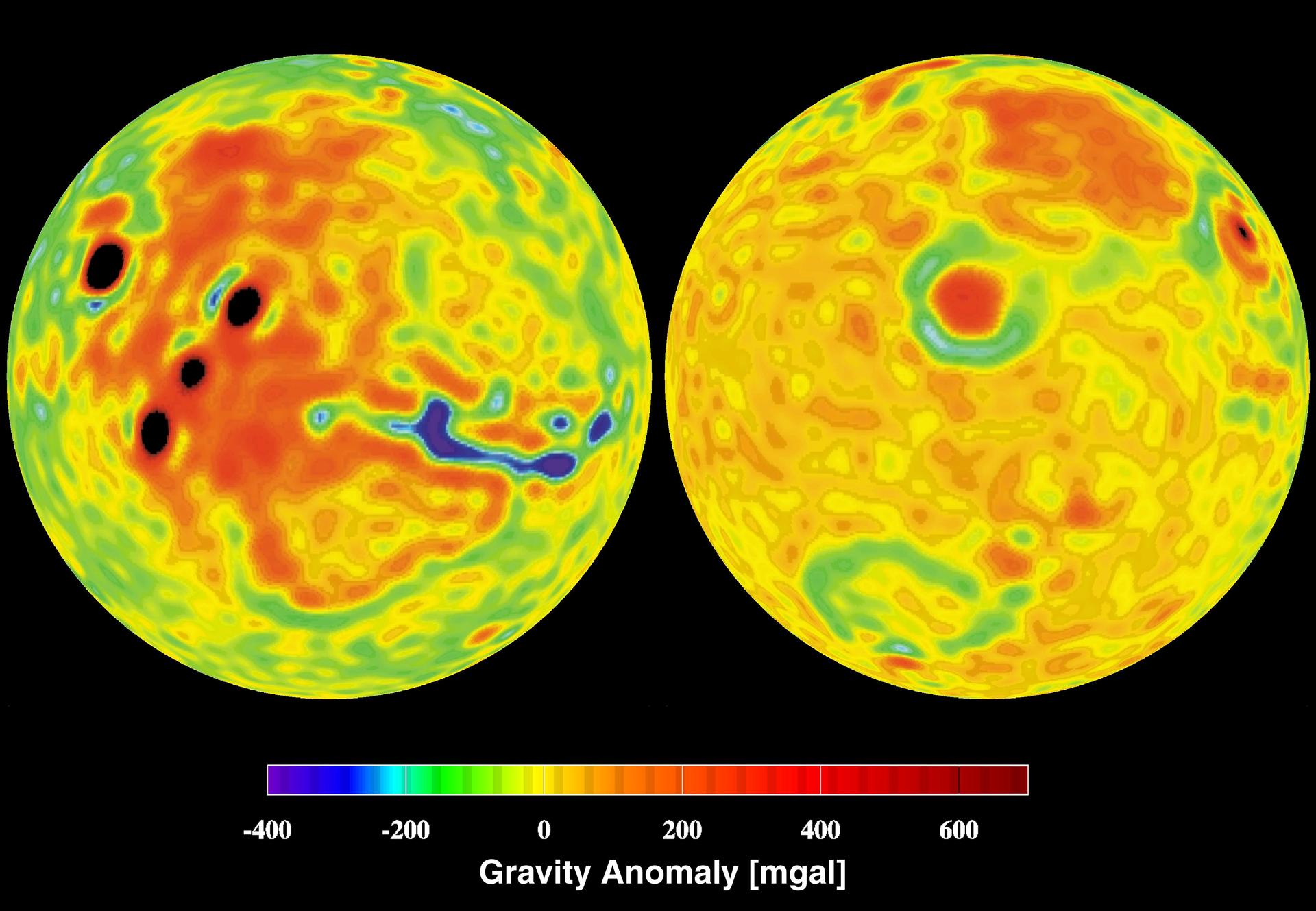
Mars gravity map showing areas of larger gravity in red

A gravity map of Mars taken by NASA’s Mars Global Surveyor (MGS). For the new study, researchers needed to find regions of Mars near Earth’s ocean level and compare the gravity and speed of those regions to Earth’s. (Image credit: NASA/JPL)

However, the shape of the trajectory was ignored in this analysis. Mars’ orbit is distorted by the gravitational pull of Earth and the Moon, making it more egg-shaped than Earth. (The effects of Mars’ moons Deimos and Phobos are negligible, Patra told Live Science in an email. Because of their small size, they are only a few miles wide, while Earth’s moon is 2,159 miles wide, or 3,475 kilometers.) So Ashby and Patra factored Mars’ orbital shape, the sun’s gravity, and Earth’s moon’s gravity into the equation.

Get the world’s most fascinating discoveries delivered straight to your inbox.

Setting the clock on Mars

The analysis showed that clocks on Mars tick an average of 477 microseconds per Earth day faster than clocks on Earth, as measured from Earth. But amazingly, this value changes by 226 microseconds (about half the offset value itself) every day of the Martian year. This variation is due to the egg-shaped orbit of Mars and changes in the gravity of nearby objects as they approach and move away from Mars.

Additionally, the researchers found that the clock changes by an additional 40 microseconds every seven synodal cycles on Mars. A synod cycle is the time it takes for Mars to reappear in the same position.

“The fluctuations and the fluctuations in the planetary dance (resonance period) of Earth and Mars were surprising,” Patra said. This is because the scale was larger than expected.

The findings, published Dec. 1 in the journal Astronomy, could help scientists synchronize time across the solar system and establish high-speed communication channels with an interplanetary internet in the distant future, but high variability will complicate the effort, Patra said. He added that the study “provides a baseline for future tests of general relativity and fundamental physics that explore the nature of spacetime.”

However, the calculations were still inaccurate by about 100 nanoseconds (0.1 microseconds) per day over long timescales because small changes in the planet’s motion were not taken into account. This inaccuracy is negligible, but it means resetting Mars’ clock every 100 days.

The study also did not take into account factors such as how the planet’s orbit precesses or wobbles over time, and the effects of Earth and Mars’ gravitational quadrupole moments (a measure of the arrangement of masses within the structure). Taken together, these limitations can make it more difficult to obtain more accurate time calculations, the researchers said.


Source link

#Biotechnology #ClimateScience #Health #Science #ScientificAdvances #ScientificResearch
Follow on Google News Follow on Flipboard
Share. Facebook Twitter Pinterest LinkedIn Tumblr Email Copy Link
Previous ArticleRivian uses custom silicon, LIDAR, and robotaxi tips to significantly enhance autonomy
Next Article OpenAI hits back at Google with GPT-5.2 after ‘Code Red’ memo
user
  • Website

Related Posts

This week’s science news: Japan’s laser weapons test bids farewell to Comet 3I/ATLAS, AI solves ‘impossible’ math problem

December 20, 2025

Interstellar comet 3I/ATLAS is rapidly moving away from us. Can we ‘intercept’ it before it leaves us forever?

December 19, 2025

AI is solving ‘impossible’ math problems. Can it best the world’s top mathematicians?

December 19, 2025
Add A Comment
Leave A Reply Cancel Reply

Latest Posts

Waymo temporarily suspends service in San Francisco as robotaxis stall due to power outage

Iran’s Infy APT resurfaces with new malware activity after years of silence

Google and Apple reportedly warned employees with visas to avoid traveling abroad

‘It felt so wrong’: Colin Angle on iRobot, the FTC, and the Amazon deal that never was

Trending Posts

Subscribe to News

Subscribe to our newsletter and never miss our latest news

Please enable JavaScript in your browser to complete this form.
Loading

Welcome to Fyself News, your go-to platform for the latest in tech, startups, inventions, sustainability, and fintech! We are a passionate team of enthusiasts committed to bringing you timely, insightful, and accurate information on the most pressing developments across these industries. Whether you’re an entrepreneur, investor, or just someone curious about the future of technology and innovation, Fyself News has something for you.

Castilla-La Mancha Ignites Innovation: fiveclmsummit Redefines Tech Future

Local Power, Health Innovation: Alcolea de Calatrava Boosts FiveCLM PoC with Community Engagement

The Future of Digital Twins in Healthcare: From Virtual Replicas to Personalized Medical Models

Human Digital Twins: The Next Tech Frontier Set to Transform Healthcare and Beyond

Facebook X (Twitter) Instagram Pinterest YouTube
  • Home
  • About Us
  • Advertise with Us
  • Contact Us
  • DMCA
  • Privacy Policy
  • Terms & Conditions
  • User-Submitted Posts
© 2025 news.fyself. Designed by by fyself.

Type above and press Enter to search. Press Esc to cancel.